#TeachTruth

Earlier this year, Parents Magazine included Our Skin: A First Conversation About Race among the “40 Best Toddler Books of All Time” alongside classic titles like The Very Hungry Caterpillar and Goodnight Moon. The book has now sold more than 130,000 copies and has been translated into Spanish, Greek, Dutch, and Korean. It’s got starred reviews from Kirkus and the School Library Journal, and has won awards from the American Library Association, the National Council for the Social Studies, and Bank Street. Heck, even 81% of the 2,068 people who have reviewed our book on Amazon have given it 5/5 stars!
The book has an impressive resume. But there are some people who really don’t like it (on Goodreads, 4% of reviewers give it 1/5 stars). When you read the negative reviews, a few clear themes emerge: 1) the definition of white supremacy is surprising, and 2) people are unsure about whether it’s appropriate for young children. As an educator who has helped thousands of children, parents, and teachers learn about systemic racism, these reactions make sense to me. In Our Skin, we address the topic in a way that is very different from the dominant “colorblind” approach that most adults in the United States were taught growing up—myself included. So I expect that some grown-ups will have strong emotional responses and need support.
This is exactly why it’s so important that we begin teaching children the truth about race and racism from an early age.
“It is easier to build strong children than to repair broken men.”
- Frederick Douglass
With care and education, I have witnessed brave communities of adults unlearn lifetimes of internalized racism and commit to racial justice; and it can be painful. It can be very hard for adults to confront realities later in life that they wish someone had told them much earlier. Perhaps especially in the context of teaching and parenting, adults care deeply about doing the right thing, and it can been jarring to encounter a new idea that challenges your sense of competence, or goodness. To rethink practices that have been passed along for generations, with the intent of benefiting children, takes real courage and humility.
But having a hard time with the book, or even going out of your way to write a negative review online, is a far cry from the extreme lengths that a small group of far-right parents are taking to ensure that nobody’s children have access to the ideas that race is a social construct and that racism is a system of power.
As the first book in the First Conversations series, Our Skin has faced bans and challenges across the country, from California to Kentucky to since it was published in 2021. In Westfield, New Jersey for example, the book was removed from school libraries after a formal complaint was made by a parent and the school board approved the decision with an 8-0 vote.
And as is true with the vast majority of book bans, censoring Our Skin was the aim of an organized pressure group with a benign-sounding name—not average parents with genuine concerns. In this case, the efforts were supported by a group called the Foundation Against Intolerance and Racism (FAIR). This group was founded by Bion Bartning (a dad who makes lots of money selling Eos lip balm) who became an anti-CRT crusader after witnessing his children be taught about the concept of “allyship” over Zoom in 2020 while enrolled in a fancy private school. This group has also attacked transgender rights, which isn’t surprising, given the fact that Maud Maron served as interim Executive Director in 2023. In case you missed it, Maud is the infamous Moms for Liberty-affiliated school board member in Manhattan who attempted whip up public panic about trans girls playing sports last year.
This is the page in Our Skin that most people struggle with:
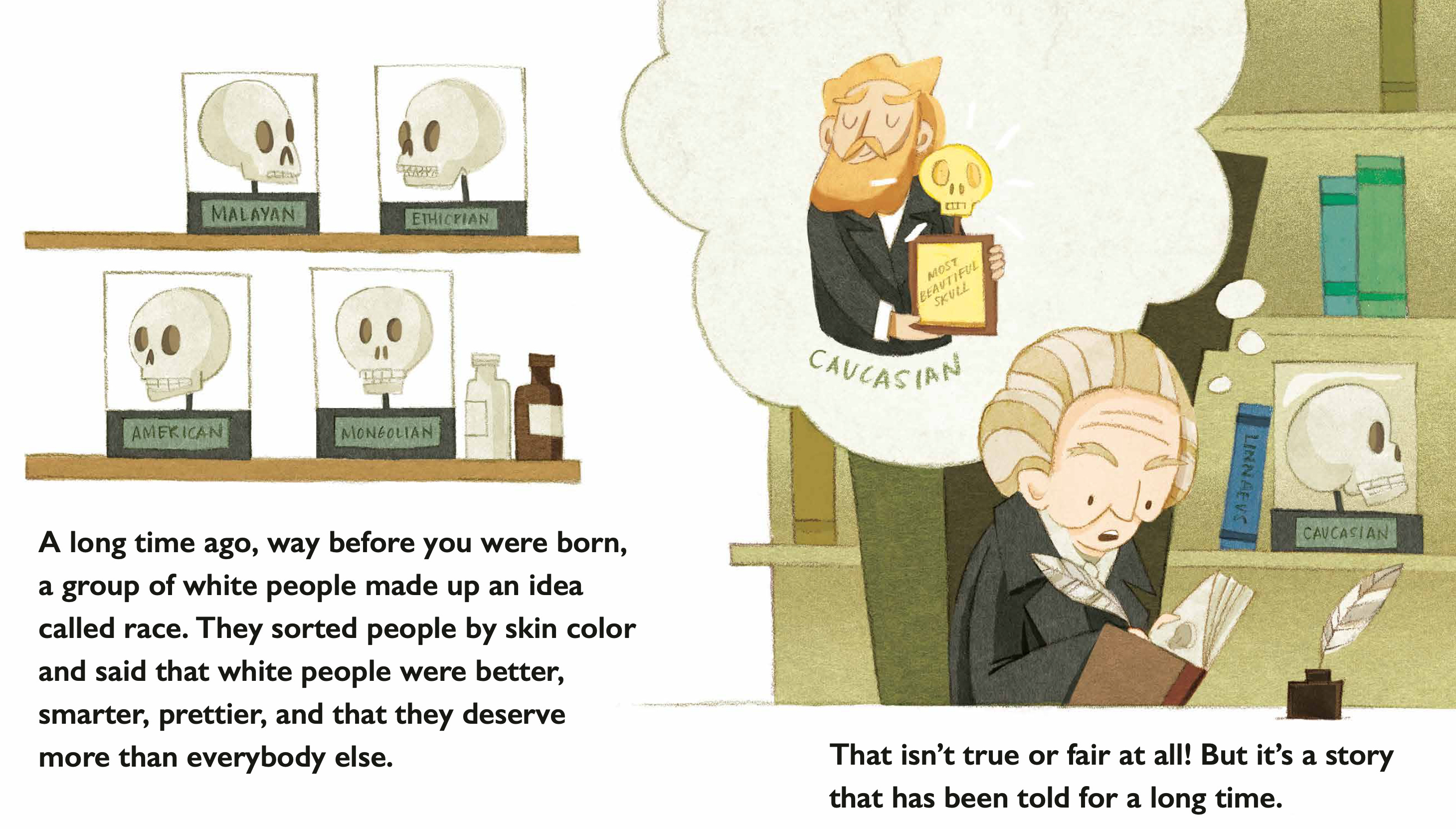
We struggled too. It’s not easy condensing several hundred years of world history into four sentences that a typically-developing four-year-old could understand. A background in early childhood education and lots and lots of practice as an anti-racist teacher educator helped, but my expertise wasn’t respected by the team. I almost walked away from the project, refusing to put my name on yet another kids books that waters down the definition of racism to something like “different people thinking different things about difference.” I felt strongly that children needed to understand that the idea of racial categories was invented by a particular group of people at a particular time in human history, and that this idea has served a specific function in society. In the end, it was the uprisings that took place in the wake of George Floyd’s murder that led our publisher to finally green light our book as written, the first children’s book in history (that I know of at least) that actually defines white supremacy in kid-friendly language.
The illustrations were even harder. The first challenge was finding an illustrator who would even agree to illustrate the text. Then once we cleared that hurdle, we went back and forth several times with the editor about how this page should look. In the end, I just typed “Johann Friedrich Blumenbach”—a real, specific guy with an actual collection of human skulls who sat down a desk and wrote the story of race that we’re living in today—into a Google image search. The picture below popped up among the search results and I emailed it to the team, suggesting that we just stick to the historical facts: there were European “scientists” like Blumenbach and Linnaeus (can you spot his book on the shelf?) who invented the idea of distinct racial categories and established a hierarchy of human value that placed their group, the group that would come to be known as white, at the top.

In the end, I felt good about how to the book turned out. As a scholar, I felt clear that this approach was aligned with the research available at the time. It’s now been amazing to learn about new studies that reinforce the importance of this kind of explicit anti-racist teaching. Perhaps more importantly, I’ve been overwhelmed with the positive feedback from children, parents, educators across a wide range of contexts. I think we did it. We somehow managed to distill the key concepts from Critical Race Theory into plain language that adults can use at home and at school to raise future generations of young people committed to racial justice from an early age.
And along with the backlash to the movement for Black lives came the backlash to our book. Well-funded hate groups are waging a coordinated narrative campaign designed to erode trust in public education. In so doing, they have made Critical Race Theory (or CRT for short) a household name. It doesn’t really matter to them that most people still don’t have any idea what CRT actually is, and that it’s never been widely taught in schools. Their goal is to foment public panic that they can leverage for political gain. The fact that these perspectives have always been marginal, even at the graduate level, makes CRT a better boogeyman. It’s easier to make people fear something they don’t know or understand.
So far, it’s a winning strategy. A national survey of teachers from 2023, before Trump took office for a second term, indicated that 2/3rds of K-12 educators were already limiting classroom conversations about social issues like race and gender. But the story’s not over yet. Studies also show that most voters oppose book bans, and most parents support talking to kids about race and racism. It’s not too late for all of us to start showing up at our local school board meetings and raising our collective voices to demand that schools #TeachTruth, starting in early childhood.
To learn more about all this, check out Jesse Hagopian’s new book, Teach Truth. This week I found out that I’m cited on page 116!


Life updates:
Went to a yoga class in the park.
Made challah and empanadas.
Had a nice weekend with Graie exploring the city.
Job updates:
I had a lovely conversation with the Principal of an elementary school in Montevideo and I’m planning on visiting next week. I hadn’t considered going back to the classroom in Uruguay, but this school is looking for an English-speaking teacher! I’d have to stop doing lots of other work (organizing, leadership, writing, research) that I have spent years learning how to do; but I’d have a salary and a community, a pathway toward residency in a country where I feel safe, and I’d get to interact with kids every day. At the very least, it feels good for an organization to express interest in learning more about me and my skills.
I got to the second round in the David Prize this year! Big thanks to everybody who encouraged me to try again.
I now have a long list of jobs and grants to apply for. Unless you think it’s a great fit, I’d hold off on sharing it. My plate is full. Thanks for your help, everybody! The next step is to carve out some time this month to work on writing them—on top of writing this Substack, three journal articles, and another children’s book—in between completing my current contracts. If anyone has capacity to help, I’d really appreciate it. I don’t really need advice or feedback, but money and/or volunteer labor would be really great.
Another grant rejection.
What I’m reading/watching:
What we get wrong about the Montgomery bus boycott – and what we can learn from it by Jeanne Theoharis
These children’s book show disability as a part of everyday life by Gene Myers
Watching Ms. Rachel: How To Advise Parents of Infants and Toddlers from the American Academy of Pediatrics
Strategic Surprise and the Future of Educational R&D by Melina Uncapher and Jeremy Roschelle
The Hidden Cost of Children’s Book Bans by Kamye Hugley
Becoming a Village by Joy Masha
Nationally, Black Girls Receive More Frequent and More Severe Discipline in School than Other Girls from the GAO
Critical Conversations: Adultification Bias Against Black Girls from Georgetown Law